














Description
Introduction
2013 EZGO RXV Gas represents a significant chapter in the evolution of gas-powered golf carts, built around the highly regarded FJ400-D Kawasaki engine that earned a reputation for durability and strong torque output. By 2013, the RXV platform had firmly established itself as a favorite among golf course operators and private owners alike, combining robust mechanical design with thoughtful features tailored to both golf and recreational use .
The FJ400-D Kawasaki Engine Heart of the RXV
Engine Architecture and Design Philosophy
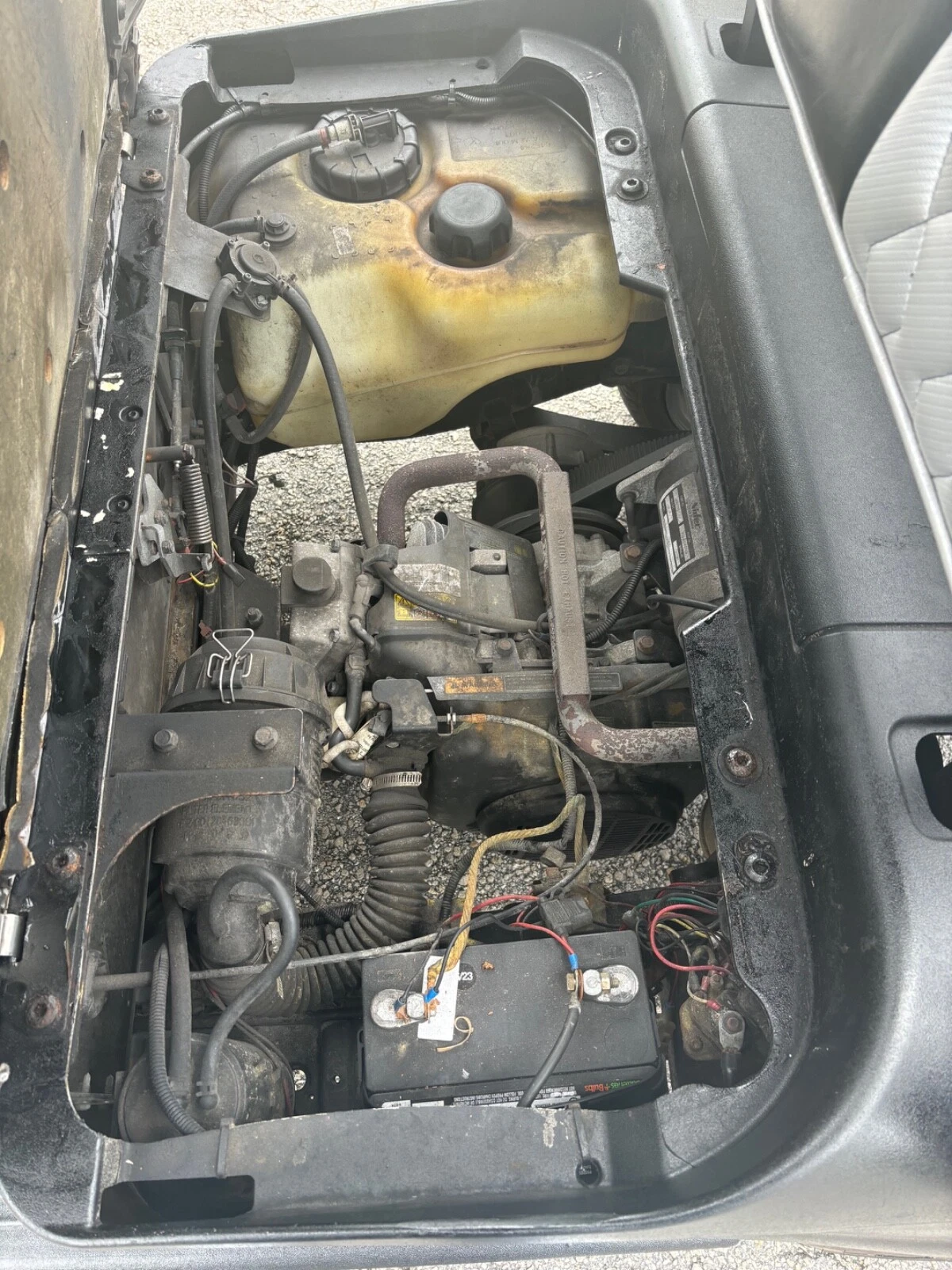
At the core of the 2013 RXV Gas lies the FJ400-D engine, a 401cc (24.5 cubic inch) single-cylinder, four-cycle, overhead valve (OHV) powerplant manufactured by Kawasaki . This engine produces 13 horsepower (9.7 kW) and is forced air-cooled, relying on airflow over cooling fins and a flywheel-mounted fan to dissipate heat . The 401cc displacement is significant—larger than many competitors’ offerings—and translates to strong torque output that proves particularly beneficial on hilly terrain or when the vehicle is carrying heavy loads.
The engine’s design incorporates several features that distinguish it from smaller utility engines. The overhead valve configuration improves breathing efficiency compared to older flathead designs, allowing for better power output and cleaner emissions. The single-cylinder layout keeps parts count low and simplifies maintenance, while the 401cc displacement provides the torque needed for demanding applications .
Pressurized Lubrication System
One of the most significant engineering features of the FJ400-D is its pressure-fed lubrication system. Unlike smaller engines that rely on splash lubrication, the RXV Gas employs a positive displacement oil pump that circulates oil under pressure to critical components—crankshaft bearings, connecting rod, camshaft, and valvetrain components . This system includes a cartridge-type full-flow oil filter that captures contaminants and debris, extending engine life considerably.
The engine also incorporates a counter-rotating balance shaft, which helps reduce vibration—a common issue with single-cylinder engines. This balance shaft contributes to a smoother operating experience compared to earlier gas golf cart engines .
Compression and Performance Characteristics
The FJ400-D engine has a specified compression range of 128 to 156 psi (9 to 11 kgf/cm²) when measured with the throttle fully open and the engine warm . This compression range is typical for an air-cooled utility engine and provides the foundation for the engine’s torque characteristics.
The spark plug is an NGK BPR2ES, gapped between 0.028 and 0.031 inches (0.70 to 0.80 mm) . The engine’s electrical system uses a transistor-type flywheel magneto, which provides reliable ignition without the need for a traditional distributor or ignition coil separate from the engine .
Powertrain and Drivetrain Components : 2013 EZGO RXV
Continuously Variable Transmission (CVT)
Power from the engine is transmitted through an automatic continuously variable transmission (CVT) . The CVT consists of a drive clutch mounted to the engine crankshaft and a driven clutch mounted to the transaxle input shaft, connected by a heavy-duty drive belt (E-Z-GO part number 606136) .
The CVT operates on centrifugal principles. At idle, the drive clutch is disengaged, allowing the engine to run without transmitting power to the wheels. As engine speed increases, weights inside the drive clutch move outward, causing the clutch sheaves to close and grip the belt, initiating power transfer. The driven clutch responds to belt tension and torque demands, adjusting its ratio continuously to maintain optimal engine RPM for the given load and speed conditions.
This system provides smooth, seamless acceleration without the need for gear changes—a significant convenience over older gas carts that required shifting between forward and reverse.
Transaxle and Drive Ratios
The CVT drives a transaxle with helical gears at a ratio of 11.42:1 in forward . The transaxle includes a neutral lock and a ground speed governor that limits the vehicle’s top speed to factory specifications. The governor is set to limit speed to 12 mph ± 0.5 mph (19 kph ± 0.8 kph) in forward on flat ground .
E-Z-GO is explicit about the consequences of modifying the governor—doing so voids the vehicle warranty and can affect vehicle stability and braking performance. For fleet operators, this speed limitation is appropriate for golf course safety; for private owners seeking higher speeds, modifications come with trade-offs that should be carefully considered.
Chassis and Structural Design : 2013 EZGO RXV
Welded Steel Frame with DuraShield Protection
The foundation of the 2013 RXV Gas is a welded tubular steel frame with DuraShield powder-coat protection . The powder-coat finishing process involves applying a dry powder electrostatically and then curing it under heat, creating a durable, chip-resistant finish that withstands exposure to moisture, chemicals, and road salts. This protection is particularly important for carts used in coastal environments or regions where roads are treated with deicing compounds.
Thermoplastic Olefin Body
The body panels are constructed from injection-molded thermoplastic polyolefin (TPO) with a base coat/clear coat finish . TPO is chosen for its combination of impact resistance, UV stability, and design flexibility. The material is flexible enough to absorb minor impacts without cracking or denting, making it ideal for golf cart applications where minor collisions with trees, curbs, or other carts are common.
Standard colors for the 2013 model year included Ivory and Forest Green . The base coat/clear coat finish provides a deep, durable appearance that maintains its luster over years of exposure to sun and weather.
Suspension Systems
The front suspension uses coil springs over hydraulic shock absorbers . This configuration provides a compliant ride while maintaining durability. The rear suspension employs leaf springs with hydraulic shock absorbers—a simpler design that is exceptionally durable and well-suited to carrying heavy loads .
While the front and rear suspension systems are not as sophisticated as independent designs found on some competitors, they offer proven reliability and straightforward maintenance. The leaf spring rear suspension maintains consistent ride height regardless of load and is less prone to wear than more complex suspension designs.
Braking System
The service brakes are dual rear wheel, self-adjusting mechanical drum brakes . Drum brakes are enclosed within the wheel hub, protecting them from dirt, water, and debris that can affect brake performance. The self-adjusting feature automatically takes up slack as brake linings wear, maintaining consistent pedal feel and stopping performance without periodic manual adjustment.
The parking brake features an automatic release system with self-compensating mechanism . This system engages automatically when the brake pedal is depressed fully and releases when the accelerator is pressed, simplifying operation for drivers.
Steering System
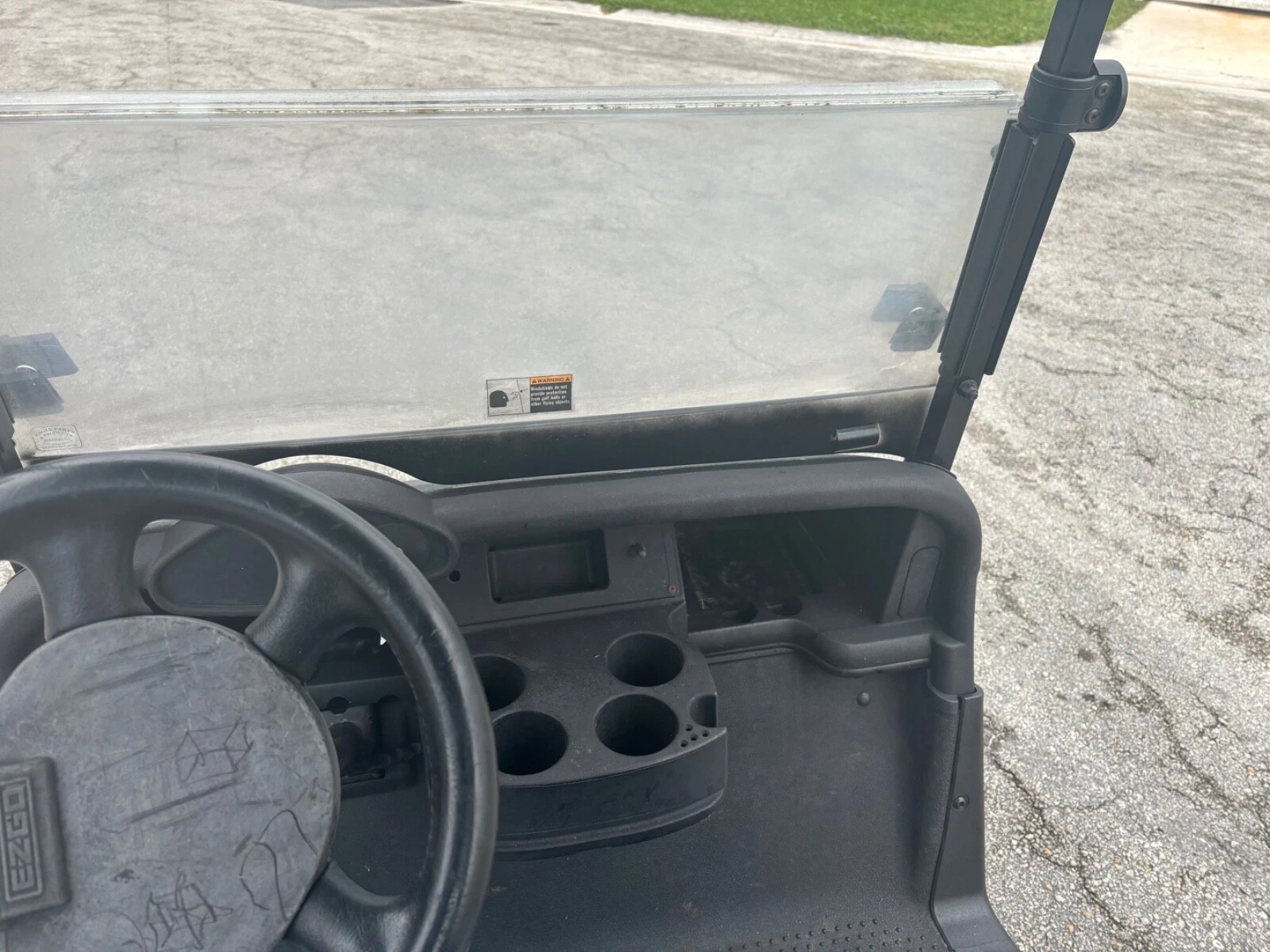
The steering system uses a single reduction rack and pinion design . The steering wheel features dual handgrips and includes an integrated scorecard holder and pencil holder—thoughtful touches for golf course use. The outside clearance circle (turning radius) is 19.0 feet (5.8 meters) .
Dimensions, Capacities, and Practical Specifications
Physical Dimensions : 2013 EZGO RXV
The 2013 RXV Gas measures 94.5 inches in overall length, 47.0 inches in width, and 70 inches in height with the roof installed . Without the roof, the height is 47.5 inches. The wheelbase is 65.7 inches, the front wheel track is 35.5 inches, and the rear wheel track is 38.0 inches . Ground clearance at the differential is 3.3 inches (8 cm) .
Weight and Load Capacity
The dry weight of the RXV Gas is 697 pounds (316 kg) . The total vehicle load capacity is 800 pounds (360 kg), including operator, passenger, accessories, and cargo . This capacity provides ample margin for two adult passengers, golf bags, and additional gear without exceeding the vehicle’s design limits.
Fuel System and Capacities
The fuel tank holds 5.1 gallons (19.3 liters) of 87 octane minimum gasoline, with a full tank weighing approximately 36 pounds . Under typical operating conditions, the RXV Gas achieves fuel economy in the range of 30 to 40 miles per gallon, yielding a practical range of approximately 150 to 200 miles per tank.
Fluid Capacities and Replacement Parts
The 2013 RXV Gas uses the following fluids and replacement parts :
Engine Oil (with filter): 1.25 liters (1.3 quarts)
Rear Axle Lubricant: 1.5 liters (51 ounces) of SAE 30 oil
Oil Filter: E-Z-GO P/N 607454
Air Filter: E-Z-GO P/N 28463G01
Spark Plug: NGK BPR2ES (E-Z-GO P/N 607462)
Starter/Generator Belt: E-Z-GO P/N 606138
Clutch Belt: E-Z-GO P/N 606136
Features and Amenities
Dashboard and Storage : 2013 EZGO RXV
The dashboard is constructed from scuff-resistant plastic and features four drink holders along with storage for balls and tees . The steering wheel integrates a scorecard holder and pencil holder—details that golfers particularly appreciate. For 2013, the RXV also featured the industry’s largest bagwell at the time, designed to accommodate modern golf bags with ease .
Operating Controls and Safety Features
The vehicle includes a removable key for security, a “deadman” accelerator control that automatically applies the brake when the pedal is released, a direction selector for forward and reverse, and an audible reverse warning indicator to alert bystanders when backing up .
The pedal-start system is simple and intuitive—press the accelerator, and the starter engages, the engine fires, and the cart moves. There is no key required for basic operation beyond the removable key that can be used to disable the vehicle when parked.
Battery and Electrical System
The electrical system is powered by a single 12-volt maintenance-free battery . This battery powers the starter generator, lights, and any accessories. The maintenance-free design eliminates the need for checking and adding water to battery cells, simplifying ownership.
Chapter 6: Real-World Performance and Driving Experience
Acceleration and Speed
The 2013 RXV Gas accelerates smoothly from a stop, with the CVT providing seamless power delivery. The 13-horsepower engine provides adequate thrust for typical golf cart applications. The factory-governed top speed of 12 mph is appropriate for golf course use, where safety and control are paramount.
Hill-Climbing Capability
One area where the RXV Gas distinguishes itself is hill-climbing capability. The 401cc engine’s torque output, combined with the CVT’s ability to maintain engine RPM in the power band, allows the cart to handle grades that challenge smaller-engined competitors. Forum discussions indicate that while the gas RXV climbs hills well, the electric AC-drive RXV has even more impressive hill-climbing ability due to its different powertrain characteristics .
Noise and Vibration
The 2013 EZGO RXV Gas was engineered with noise and vibration considerations. The sound pressure level is rated at 70 db(A) or less on the A-weighted scale . For context, this is comparable to the noise level of a normal conversation or a vacuum cleaner at close range. The vibration levels, measured according to ISO 2631 and ISO 5349 standards, are less than 2.5 m/s² for both whole-body vibration (WBV) and hand-arm vibration (HAV) .
However, owner feedback suggests that the gas RXV is notably louder and produces more vibration than its electric counterpart. One forum user described the gas RXV as “a shaking, rattling noisy turd” compared to the electric version . This reflects the inherent trade-off between the simplicity and range of gas power versus the refinement of electric propulsion.
Maintenance Requirements : 2013 EZGO RXV
Periodic Service Schedule
The 2013 EZGO RXV Gas has a comprehensive periodic service schedule designed to maintain reliability and extend vehicle life . Key maintenance intervals include:
Tire pressure and condition
Loose or missing hardware
Reverse warning indicator function
Overall vehicle condition
Weekly/20 Rounds/100 Miles:
Battery charge condition and terminal cleanliness
Service brake operation
Park brake operation on hills
Accelerator smooth operation
Monthly/60 Rounds/300 Miles:
Starter/generator belt tension and wear
Wiring connections and insulation
Carburetor linkage attachment
Quarterly/125 Rounds/600 Miles:
Air filter element check and replacement as needed
Cooling fan screen cleaning
Carburetor cleaning
Semi-Annual/250 Rounds/1,200 Miles:
Engine oil and filter change
Valve clearance check (requires reference to repair manual)
Annual:
Spark plug replacement
Every 5 Years:
Rear axle fluid replacement (unless leakage is evident earlier)
Routine Maintenance Procedures
The engine oil should be checked with the engine warm, with the vehicle on a level surface and the parking brake engaged . Owners should allow adequate time for oil to drain into the crankcase before checking. Overfilling the engine can cause smoking or allow oil to enter the air filter enclosure .
The spark plug should be removed and inspected when the engine is cold . Common spark plug issues include sooty deposits (which can be cleaned with a wire brush), fouling from dirty air filters or poor fuel quality, and incorrect gap settings . When reinstalling, apply a light coat of anti-seize compound to the threads and tighten to 87-121 in. lb (9.8-13.7 Nm) torque—over-tightening can damage the aluminum cylinder head threads .
The RXV Gas in Context
Gas vs. Electric: The 2013 RXV Choice
For buyers considering a 2013 RXV, the choice between gas and electric versions involves several trade-offs . The electric RXV features an AC drive system that provides impressive hill-climbing ability and can be programmed for higher top speeds. The electric version is also quieter and produces less vibration.
However, the gas version offers advantages in range and refueling convenience. With a 5.1-gallon tank and fuel economy of 30-40 mpg, the gas RXV can travel 150-200 miles between fill-ups—far beyond the range of a standard electric cart on a single charge. For users who need to operate continuously throughout the day without charging downtime, the gas version remains attractive.
Modification Potential
Forum discussions indicate that the electric RXV has more potential for performance modification—through controller reprogramming or aftermarket controllers—than the gas version . The gas RXV is limited by its engine displacement and governor, and modifications to increase speed or power come with greater risk and complexity.
For owners who like to “tinker” with their vehicles, the TXT platform (rather than the RXV) is often recommended, as modifications carry lower risk of damaging sensitive electronic controllers .
The Modern RXV Evolution
Since 2013, the RXV platform has evolved considerably. Current RXV gas models now feature the EX1 engine—a 150cc single-cylinder OHC design with closed-loop electronic fuel injection (EFI) that produces 11.5 horsepower . This represents a significant advancement over the carbureted 401cc engine of the 2013 model, offering better fuel efficiency, easier starting, and reduced emissions.
The electric version now offers ELiTE lithium battery technology, providing reduced weight and improved efficiency over traditional lead-acid batteries . These modern advancements have made the RXV platform more sophisticated, but they have also increased complexity compared to the simpler 2013 model.
Conclusion
The 2013 EZGO RXV Gas represents a mature expression of gas-powered golf cart engineering—a vehicle that had been refined through years of production experience while maintaining the straightforward design principles that made it reliable. The FJ400-D Kawasaki engine, with its 401cc displacement and pressure-fed lubrication system, provides the torque and durability that owners expect from a gas utility vehicle.






Reviews
There are no reviews yet.